The Gaps That Give You Away: Why Wedding Photos Need the Awkward Bits
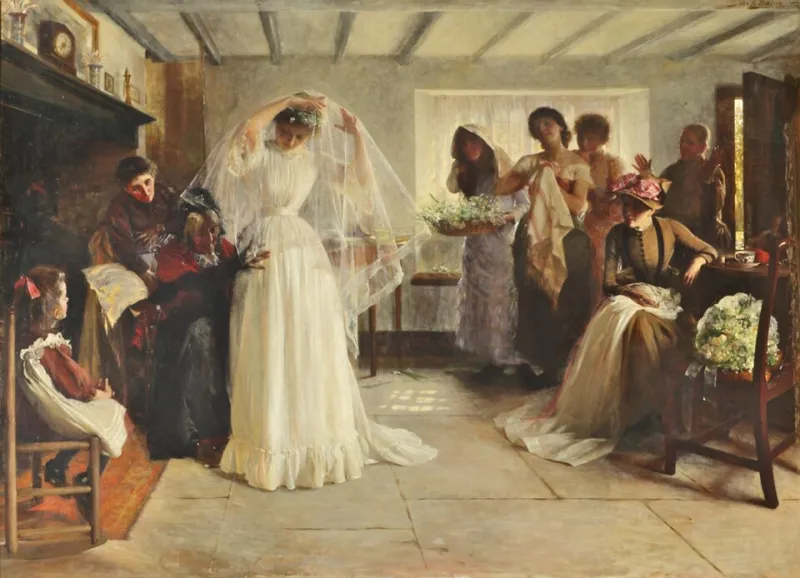
Photo: John Henry Frederick Bacon, Public domain, via Wikimedia Commons
The frame I remember from a wedding is rarely the one on the mood board. It is not the confetti shot or the first dance. It is the groom's mum holding a box of favours in a village hall at 9.12am, still in her coat, reading the side of the box like it might contain instructions for the day. It is the bride and her dad sitting in a Premier Inn car park, saying nothing, because the car is early and the church is not ready. It is the two of them in the back of a hired car twenty minutes after the vows, shoes off, staring out of opposite windows.
Those are the gaps. The dead time. The bits that wedding timelines often try to delete. I think they are the story.
The myth of the seamless day
Wedding media sells a seamless day. The timeline is tight, the drinks reception is a content opportunity, and every minute has a job. There is nothing wrong with a plan - I like a plan - but a wedding is not a film set. It is a day full of waiting, travelling, buttonholes, lost rings, parking, family politics and quiet nerves.
In the UK, that is especially true. A village church, a registry office, a marquee in a field, a pub back room, a minibus between two towns: the day is stitched together by small journeys and pauses. The gaps are not failures of organisation. They are where people actually live.
What the in-between actually looks like
From behind the lens, the in-between has a texture that the big moments do not. It is the venue setup: chairs being wiped, a cousin on a ladder with fairy lights, the caterer asking where to put the cake. It is the travel: a dad checking the route on his phone, bridesmaids sharing a mirror in a service station, the couple's hands finding each other in the back seat. It is the waiting: guests arriving early and hovering by the church door, the registrar tapping a clipboard, the flower girl spinning on a pew.
And it is the quiet minutes before the ceremony. That is the one I would protect above almost anything else. The couple are ready. The guests are seated. The music is cued. For ten minutes, the day is holding its breath. If you fill that with a staged first look, a phone call, or a well-meaning aunt, you lose something you cannot get back.
Why couples should protect the gaps
The practical argument is simple: gaps absorb delay. A UK wedding day can lose twenty minutes to traffic, a missing buttonhole or a vicar who wants a word. If every minute is booked, the whole day goes into debt by lunchtime. If you build in a buffer, the day can breathe.
The emotional argument is better. The gaps are where people drop their performance. They are where the nerves show, where the jokes happen, where the family dynamics are visible without anyone having to explain them. Those photographs are not always flattering, but they are true. And true is what you will want in twenty years.
So how do you protect them without turning the day into a staged shoot?
First, do not schedule anything for the twenty minutes before the ceremony. Tell your photographer, your planner and your venue. Ask for a room, a corridor or a corner where the couple can wait without being asked about the seating plan. If people want to see them, they can see them afterwards.
Second, be realistic about travel. A twenty-five-minute drive between ceremony and reception is not twenty-five minutes in the day. It is ten minutes of gathering bags, five minutes of finding the car, and ten minutes of someone realising the rings are in the other jacket. Build the buffer in and let the photographer travel with you or follow close behind.
Third, give the venue setup some air. If you can, let the photographer arrive two hours before the ceremony. The morning setup is full of small, useful story: the people who made the day happen, the borrowed cake stand, the hand-written signs, the moment the marquee finally looks like a wedding.
Fourth, resist the urge to fill the drinks reception with formal photographs. Group shots are fine, but they are not the whole story. Leave fifteen minutes after the ceremony for the couple to be alone, even if that means the guests start on the prosecco without them. They will catch up.
Behind the lens: prompts, timing and storytelling
When I photograph the in-between, I am not posing people. I am looking for a task. A task gives people somewhere to put their attention, which is usually all they need.
Useful prompts are small and practical: Who has the rings? What is in your pockets? Can you show me what you are doing? What have you forgotten? Where is the buttonhole box? These are not jokes for the sake of it. They give me a frame and give people something to do.
Timing matters more than prompts. Arrive early. Stay at the edges. Do not interrupt a conversation to ask for a smile. If the couple are waiting in a room, photograph the room first, then them. If the guests are arriving, stand by the door and let the greetings happen. If the car is late, photograph the waiting, not the timetable.
I use a 35mm lens for most of this, sometimes a 50mm. No flash if I can help it. I want to be close enough to see the hands, but far enough that people forget I am there. The storytelling is in the sequence: a wide frame of the hall before anyone arrives, a medium frame of the dad doing up his tie, a detail of the order of service on a chair. That is how a gap becomes a scene.
Making it work on a UK timeline
A simple shape might look like this. Photographer arrives at 11am for venue setup. Couple get ready separately, with a calm hour and no back-to-back appointments. Guests arrive from 1pm. The couple have twenty minutes out of sight before a 1.30pm ceremony. Drinks from 2pm. The couple take fifteen minutes alone at 2.45pm. Group shots at 3pm, kept short. Travel at 3.45pm, with a realistic buffer. Reception at 4.30pm.
That is not a rigid formula. It is a permission slip. The day does not need to be full to be complete. The gaps are not dead time. They are the story.
And the awkward bits? They are usually the bits that give you away. Keep them.