Faces, Not Lecterns: Where the Wedding Speech Story Really Lives
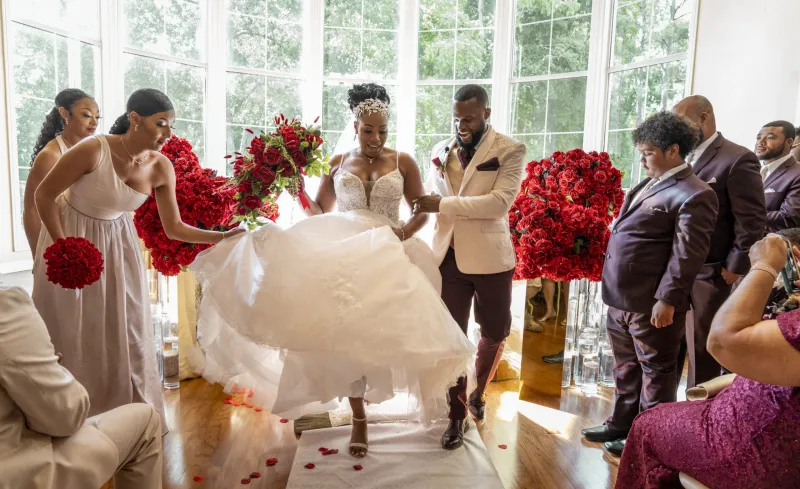
Photo: wedding guests reacting laughing during speeches reception candid, via springsvenue.com
The speeches are the one part of a wedding where nothing is staged and everything is happening at once. The usual solution is to plant yourself at the front and fire away at whoever has the microphone. Nine times out of ten, that's the least interesting frame in the room.
Here's what I look for instead, and how I go about getting it without turning the toast into a photo call.
The shot everyone expects
A speech photograph has a predictable shape: subject centre-frame, glass in hand, mouth open, top table slightly out of focus behind. It's not wrong. It's just the caption rather than the story. Couples rarely print it. They print the one where their dad is laughing so hard he's had to put his head in his hands.
That photograph is not at the lectern. It's at table four, between the aunt who's crying and the cousin who's filming it on a phone.
Walk the room before anyone stands up
I do this during the main course, when people are relaxed and nobody is watching me. Ten minutes, a glass of water, a slow lap of the room.
What am I actually looking for? Where the light falls. Whether the top table is backlit by a window — a common problem in marquees and hotel function rooms, and one you can't fix once the speech has started. Where the gaps between tables are wide enough to stand in without becoming the entertainment. And which faces are likely to react: the bride's mother, the best man's partner, the grandfather who's been at these weddings since the seventies.
I'll also find out from the couple, in advance, roughly who's speaking and in what order. It matters. The father of the bride's speech is nervous laughter and sentiment. The best man's is where the room goes feral.
The three-second rule
Almost every photograph you want happens in the gap between the punchline landing and the laugh arriving. That gap is about three seconds long, sometimes less.
The practical consequence is that you don't chase. You pick a face, you get focus, and you wait. A mirrorless body with eye detection and a silent shutter makes this far easier than it used to be — nobody in the room knows they're being watched, so they don't straighten up.
Don't reframe constantly. Don't swing across the room looking for something better. Commit to one person, let the moment come to you, then move on.
Glass, lenses, settings
My default is a 35mm or 50mm, wide open, 1/250th, auto ISO and no flash. Wide-ish lets you keep the speaker's shoulder or the back of someone's head in the corner of the frame, which gives the picture a sense of place.
For tears — and there are always tears — I'll switch to an 85mm and step back. It compresses the room, blurs the clutter of plates and half-drunk wine, and lets me stay at a distance that doesn't feel intrusive.
On flash: in a big, high-ceilinged room, a bounce is fine. In a small village hall where the ceiling is two feet above the groom's head, put it away. Nothing ends a speech photograph faster than a burst of white light at the exact moment someone's voice goes.
The geography of a UK wedding breakfast
Venue shapes the job more than any camera setting. A top table against a wall means everyone faces the same direction — good for reaction shots, terrible for angles. Long trestle tables mean you can walk the length of the room behind the guests. A hotel function room with a chandelier is going to flatten everything, so you work the edges where the light falls off.
Marquees are their own thing entirely, usually because of the noise. If the sound is bouncing, the reactions are bigger; people lean in, put hands to faces, react more physically because they're already straining to hear.
Be furniture
Etiquette, because this is where photographers get it wrong.
Agree with the couple beforehand where you'll be during the speeches. Never cross the floor mid-toast. Never step in front of a grandparent — they've waited all day for this. If someone's crying, wait two frames and then move on; a face held on for ten seconds reads as a lens in the eye.
And don't eat while you're shooting. It's amazing how much goodwill you lose by being the person holding a canapé in the middle of the father of the bride's big moment.
The grimace counts
The groom's face when the story about Ibiza comes out. The bride's sister doing a slow, silent 'no'. The usher who's had three glasses of red and is going the colour of it. These are the frames the couple text to each other on the train home.
There's a temptation to cull them, to only deliver the flattering ones. I don't. A wedding gallery that only contains people looking lovely is a catalogue, not a story. The grimace, the wet-eyed laugh, the completely undignified snort — they're the evidence that the day actually happened.
Editing the room, not the faces
Two rules. Don't retouch tears out. Don't straighten a crying face into a smile. If someone's mascara has gone, leave it; it's the picture.
What I will do is lift the shadows in a dark function room and calm the colour cast from a hundred tea lights. The aim is that the room looks the way you remember it feeling, not the way it was metered.
Where to put the camera down
The last thing, and the one I've learned most slowly. Somewhere in the third speech there's a moment — the bride's hand on her father's arm, a look between two people who've been married forty years — that has nothing to do with the microphone. When that happens, stop working the room and stand still. Sometimes the best speech photograph is the one where nobody is speaking at all.