Everyone's a Photographer Now: Friendly Ground Rules for Guest Snaps at Your Wedding
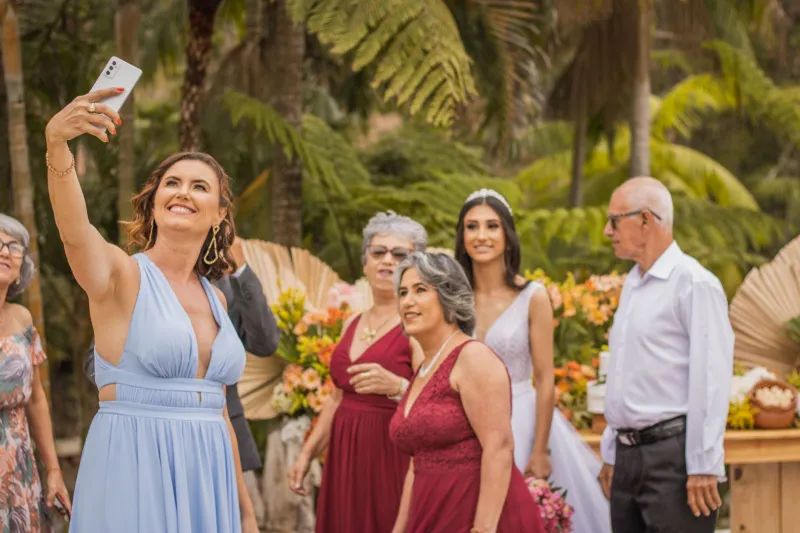
There is a moment at nearly every wedding when you look up from the confetti and realise that half your guests are watching the day through a phone screen. Someone's uncle is conducting a full documentary shoot on an iPhone. A cousin is live-streaming the first dance to an audience of three. And the professional photographer is politely orbiting the edge of a small crowd of raised devices, waiting for a gap. It is not a disaster. It is just modern wedding life. The trick is to decide, early and kindly, what role you want guest photos to play in your day.
Start with what you actually want
Before you write any signs or send any messages, have a proper conversation with your partner. Do you want the ceremony to be phone-free, or are you happy for people to snap away quietly? Do you care about a clean aisle in the church, or is the chaos part of the charm? Would you rather guests were present at the drinks reception, or are you secretly delighted that Auntie Jean got a wobbly video of you laughing with your dad?
Most couples land somewhere in the middle. They want the ceremony protected, the group shots efficient, and the rest of the day open to friendly snapping. That is a perfectly reasonable position. The mistake is assuming guests will intuit it. They will not. They will do what feels natural in the moment, which usually means taking out a phone the second something emotional happens. Tell them what you have decided, lightly, and give them a reason that sounds like care rather than control.
The ceremony is not a press conference
If there is one part of the day worth protecting, it is usually the vows. This is where the pavement-blocking camera clusters really begin: guests leaning into the aisle, phones held aloft, a slow-motion shuffle of people trying to get the perfect angle while the registrar is halfway through the important bit. It is not malicious. It is just enthusiasm with a zoom lens.
A short note from the celebrant or officiant works wonders. Something like: 'The couple have asked for an unplugged ceremony. Please keep phones and cameras away until they walk back down the aisle.' You can put it on a small sign, in the order of service, or simply have someone announce it warmly before you begin. It gives guests permission to put the phone away, which many of them secretly want. If you are getting married in a church or registry office, check the venue's own photography rules first, then fold them into your plan. A little clarity saves a lot of quiet frustration later.
Build in a five-minute phone window
Banning phones entirely can feel a bit severe, especially if you have guests who have travelled far or family who cannot be there in person. A gentler approach is to give guest photography a clear window. Maybe your celebrant invites everyone to take a photo as you sign the register. Maybe you ask the photographer to step back for sixty seconds after the first kiss so guests can get their shot. Maybe you make an announcement at the drinks reception: 'Right, phones out for five minutes, then put them away and come and have a drink.'
This works because it meets the urge head-on. Guests get their picture, you get your moment, and nobody spends the whole ceremony trying to sneak a phone out of a handbag. It also helps your professional photographer, who can plan around the window rather than fighting for space during it.
Keep the aisles clear, and the pavement too
UK venues are rarely designed for camera crews. Narrow church paths, pub gardens with one decent bit of shade, a marquee entrance that becomes a bottleneck the second the group shots begin. If you want the professional portraits to run smoothly, ask a friend or usher to be a gentle photo shepherd. Their job is not to police anyone. It is to keep the main sightlines clear, help elderly relatives find a seat, and stop Uncle Dave from backing into a flower bed.
A simple line works: 'We're just doing the group shots now, then you can snap away.' Most people respond well to being told what is happening next. It is the uncertainty that makes guests crowd. If you have a large family, consider printing a short list of group combinations and handing it to the shepherd. It keeps the energy light and stops the photographer from becoming a traffic cone.
Give guests a job that is not 'get in the way'
One of the kindest things you can do for your guest photographers is give them a specific brief. Ask one or two trusted friends to capture the bits the professional might miss: the grandparents holding hands, the kids tearing around the lawn, the very late-night dancing. Call them your unofficial documentarians. It makes them feel useful, and it takes the pressure off everyone else to document every single second.
You can also lean into the candid spirit. Some of the best guest photos are not the polished ones. They are the blurry ones, the ones taken from a slightly odd angle, the ones where someone is mid-laugh and nobody is posing. Those images have a different kind of honesty. They sit beautifully alongside the professional portraits, and they often become the ones you return to when you want to remember how the day actually felt.
Collecting the good stuff afterwards
Once the wedding is over, the photos will arrive in a slow, chaotic trickle. A WhatsApp group here, a shared album there, three blurry videos from a cousin who has not discovered landscape mode. Make it easy on yourself. Set up one shared album before the day and put the link on a small card at the reception, or ask a friend to remind people at the end of the night. If you are using a QR code, test it on someone else's phone first. Do not assume it will work just because it looked neat on your laptop.
When the images come in, save the ones you love straight away. Thank the people who sent them. And try not to compare the guest album to the professional gallery. They are doing different jobs. One is a record of how it looked. The other is a record of how it felt from the inside.
Let the day be the day
The best guest photography policy is not a policy at all. It is a tone. Be clear about the moments you want protected, generous about the rest, and relaxed about the fact that people will take pictures. You are not running a press conference. You are getting married, in front of the people who love you, and some of them will express that love by holding up a phone. Let them. Just make sure you also look up, catch the light, and let the day happen without watching it through someone else's screen.